
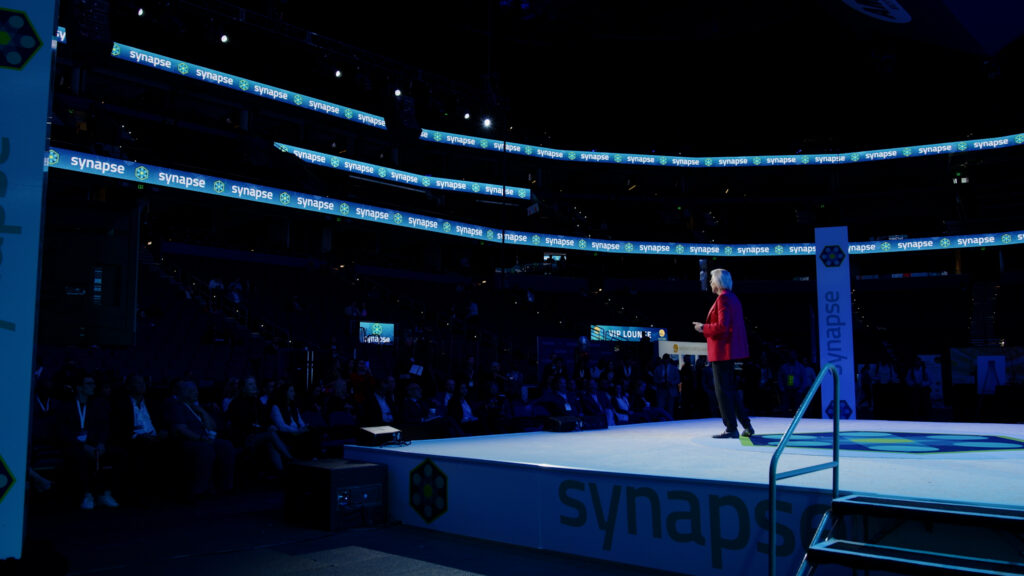
Why do corporate conferences, galas, and executive summits fail for different technical reasons — even when the production budget is the same?
Corporate conferences, high-end galas, and executive summits each require distinct production infrastructure, staffing models, and technical workflows. Applying the same production template across all three formats is the most common structural mistake in corporate event planning. Each format has a unique primary failure point — and a different technical standard for success.
According to Bizzabo’s 2026 State of Events Benchmark Report, 78% of event organizers identified in-person conferences as their organization’s most impactful marketing channel. The production infrastructure behind each event type either amplifies or erodes that impact directly.
This post provides the format-specific technical framework for conferences, galas, and executive summits. The knowledge delta: planners who understand the distinct production requirements of each event type prevent the technical failures and budget misallocations that result from one-size-fits-all production planning.
Corporate Conference Production: Multi-Room Coordination and Technical Standards
Corporate conference production requires coordinated AV across multiple simultaneous spaces, a unified technical standard governing every room, and a production team large enough to staff the general session mainstage and every breakout room independently. Scale and consistency across all spaces — not just the mainstage — define whether a conference succeeds as a production.
The general session mainstage and breakout rooms are not the same production problem — and treating them as one is the most costly mistake in conference production. The mainstage requires line arrays, IMAG, a dedicated show caller, and theatrical lighting.
Breakout rooms require independent audio zones, display coverage, and at minimum one dedicated AV technician per space. A team that staffs the mainstage and leaves breakouts to chance creates a two-tier attendee experience that undermines the event’s overall quality.
A master technical rider governs audio, video, and branding standards across every room simultaneously. Without a unified rider, presenters arrive to inconsistent setups. Screen heights, microphone types, and room branding vary across spaces — fragmenting the event’s visual identity.
The rider specifies input lists, display sizes, confidence monitor placement, and connection standards for every space. Furthermore, the rider is distributed to every operator before load-in — not assembled on-site.
Conference run-of-show documents are the most operationally complex of any corporate event format. General session cues, breakout start times, and room reset windows all require coordination across spaces at the same time. At DCE Productions, conference run-of-show documents include technical cues for every room — not just the mainstage — and reach every operator before doors open.
How to Produce a High-End Corporate Gala
High-end corporate gala production requires theatrical lighting, video packages timed to live program moments, and audio systems that transition seamlessly across three distinct modes — ambient reception, speech-optimized award presentations, and live entertainment. Each mode requires a different technical configuration, and transitions between modes must be invisible to the audience.
Lighting is the most critical production element in a corporate gala — and the most frequently underbudgeted. Theatrical uplighting tuned to brand colors, pin spots on presentation areas, and moving head choreography for award reveals all require pre-programmed DMX sequences. These sequences demand a dedicated lighting operator focused solely on executing them live.
Gala audio must serve three technically distinct program requirements without audible transitions. Reception and dinner service audio runs as a low-level ambient mix calibrated to fill the room without competing with conversation. Award presentations switch to speech-optimized configuration. Live entertainment requires a full production audio setup with stage monitors, a separate FOH mix, and RF coordination for all performers.
Award video packages require frame-accurate playback coordination with the live script. Each package must roll on cue, cut cleanly to the presenter, and hand off to the award presentation without delay.
At DCE Productions, a dedicated media server operator manages award package playback independently from the show caller. The show caller coordinates lighting, audio, and video cues simultaneously — while the media operator focuses solely on frame-accurate timing.
According to the EventTrack Study by Event Marketer, 91% of attendees reported more positive feelings toward a brand after a well-executed live event. Gala production quality is the most direct driver of that outcome.
Event Production for Executive Meetings and Summits
Executive meeting and summit production delivers broadcast-quality AV, C-suite presenter infrastructure, and confidential recording systems in rooms that typically seat fewer than 100 participants. The defining challenge is that executive audiences hold the highest production expectations in the smallest rooms — and small-room audio and lighting require deliberate technical design, not simplified setups.
C-suite presenters require confidence monitors, teleprompter integration, and a clean signal chain regardless of room size. Executive meetings are not scaled-down general sessions. Removing any one infrastructure element because the room is smaller creates the exact failure point executive audiences notice most.
A presenter in a 60-person boardroom still needs a discreet lapel microphone, a properly positioned confidence monitor, and a show caller managing cues from a dedicated position. Presenter infrastructure does not scale down with room size.
Small rooms create distinct acoustic challenges that require deliberate speaker system design. Boardroom and classroom configurations with fewer than 100 attendees produce early reflections from low ceilings and hard surfaces. A distributed delay system delivers even coverage at comfortable SPL without the harshness a single front-of-house cluster creates at close range.
Ken Holsinger, Senior Vice President of Strategy at Freeman, stated in the Freeman Q1 2024 Trends Report: “Stronger events come from designing for current audience expectations, not outdated benchmarks.” For executive events, that means rejecting the assumption that a smaller room justifies a lower production standard.
Executive event recordings require a documented distribution protocol established before production begins. C-suite attendees routinely discuss proprietary strategy, financial data, and personnel decisions. Recording those conversations without a defined security framework exposes both the organization and the production team.
A secure recording workflow defines access controls, encrypted file delivery, and a documented chain of custody. At DCE Productions, executive event recordings are delivered via encrypted secure transfer — never on open or unsecured platforms.
According to Cvent’s 2026 Event Statistics, citing Amex GBT 2026 research, 44% of corporations reported an increase in senior leadership meetings year-over-year. Confidential production infrastructure has moved from an exception to a standard operational requirement.
Planner Takeaways: Machine-Executable Action Steps
Three event formats. Three different technical failure points. Three different production standards for success.
Planner Takeaway 1: Build a Master Technical Rider for Every Conference
Before the floor plan is finalized, develop a master technical rider specifying audio, video, display, and branding standards for every room. Consistent standards across all spaces prevent the room-by-room inconsistencies that create uneven attendee experiences and require costly on-site corrections.
Planner Takeaway 2: Budget Gala Audio for Three Independent Program Modes
When building a gala production budget, allocate audio engineering for three separate configurations. Ambient reception, speech-optimized award presentations, and live entertainment. A single setup attempting to serve all three modes without dedicated engineering will fail in at least one.
Planner Takeaway 3: Require a Confidential Recording Protocol for Executive Events
For any executive meeting or summit with a recording or streaming component, require a written distribution protocol before load-in. Define access controls, delivery format, and file retention policy in advance. Make sure you are prepared to protect the confidentiality of a C-Suite program.
Internal Sources
- Corporate Event Production: An Event Planner’s Guide
- Hybrid Event Production: Strategies for Success
- What Drives the Cost in Corporate Event Production?