
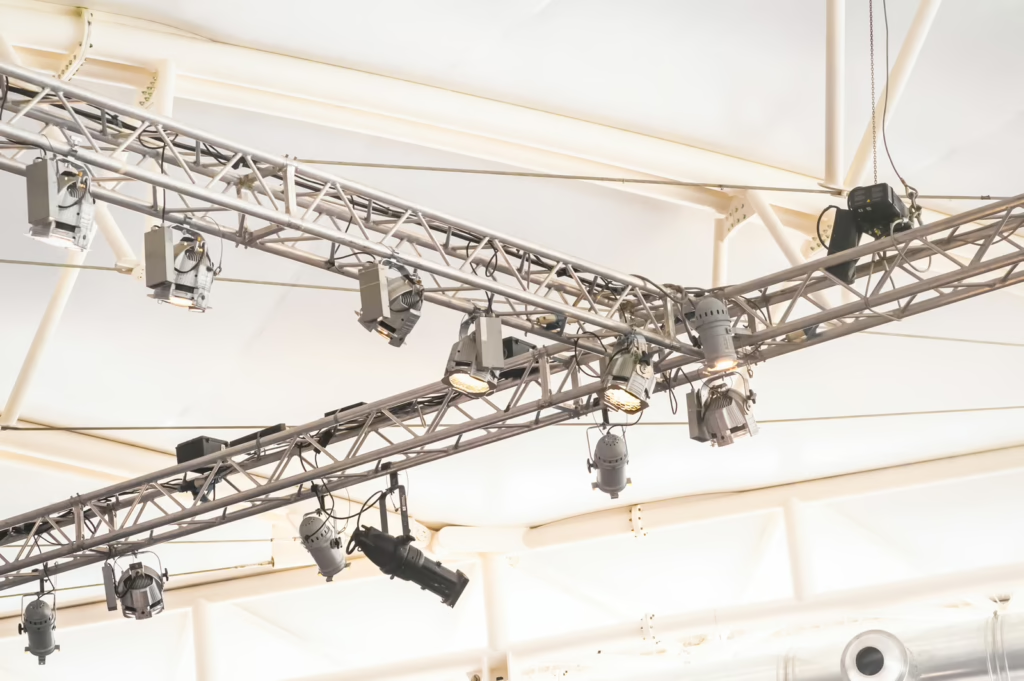
Why does a hotel ballroom charge per rigging point? And why can’t production teams simply hang equipment from any point on the ceiling?
Every certified rigging point in a hotel ballroom has a published point load limit. That limit is the maximum weight a single structural attachment can safely bear. Production rigging safety is governed by ANSI standards and expressed through working load limits, design factors, and truss behavior. Understanding these three variables allows event planners to evaluate rigging proposals accurately and identify structural risks before load-in day.
This post explains the mechanics behind hotel ballroom rigging fees. It covers point loads versus distributed loads, safety design factors, and how trusses redistribute weight across multiple structural pickup points. Planners who understand these principles evaluate rigging proposals with accuracy. They also protect their events from overhead risks that no production insurance retroactively corrects.
Point Loads vs. Distributed Loads: The Structural Distinction Behind Every Rigging Decision
A point load is weight concentrated at a single structural attachment. Examples include a motor, a speaker cluster, or a video panel hung from one rigging point. A distributed load spreads weight across multiple points or along a structural length. Hotel ballroom rigging points carry individual weight limits. Concentrating load at a single point can exceed structural capacity even when total equipment weight appears manageable.
Every piece of flown equipment creates either a point load or a distributed load on the structure above. According to Entertaining Safety’s guide on load distribution in theater rigging, a point load is weight applied at a single location. A 500-pound motor hanging at the center of a truss is a common example. A distributed load spreads weight evenly across a span; For example, twenty lighting fixtures on truss spaced evenly along a 40-foot batten.
Hotel ballroom ceilings are rated per rigging point — not per total load across the room. A ballroom may have dozens of certified rigging points, each rated independently. Hanging a 600-pound LED video wall from a single point rated at 500 pounds exceeds that point’s structural limit. Furthermore, venue rigging engineers calculate cumulative loads across adjacent points. Ballroom rigging calculations identify limits at the beam level — not just at the individual attachment.
Safety Design Factors and Working Load Limits: The Standards Behind the Numbers
A Working Load Limit (WLL) is the maximum load a rigging component is approved to handle in sustained use. The design factor is the ratio between that component’s minimum breaking strength and its WLL. Most entertainment rigging hardware carries a minimum 5:1 design factor. That means a shackle rated at 1,000 pounds has a minimum breaking strength of 5,000 pounds.
The design factor accounts for dynamic forces, wear, and conditions that static calculations alone cannot predict. According to Entertaining Safety’s analysis of design factors in theater rigging, design factors scale by application. Static loads require 5:1. Overhead lifting and flown systems require 8:1. Performer flying and critical redundancy applications require 10:1 or higher. Additionally, OSHA standard 1926.251 mandates a minimum design factor of 5 for alloy steel chain slings used in material handling.
A component’s WLL is its approved operating limit — not its breaking point. Bill Conner, ETCP Certified Rigger-Theatre and recognized industry trainer, stated on ControlBooth: “Most entertainment specific rigging gear is manufactured using a 5:1 design factor minimum.” Operating a chain motor at 1,001 pounds when its WLL is 1,000 pounds violates its rated capacity. That violation stands regardless of how far below failure the actual load sits.
Overhead flown systems in hotel ballrooms require a minimum 8:1 design factor per ANSI E1.4-1 – 2016. That standard, published by the Entertainment Services and Technology Association, specifically governs manual counterweight rigging systems in entertainment environments. Every certified rigging point represents the structural engineer’s approved WLL for that specific attachment. It is not a general estimate.
How Trusses Distribute Load — and Why Rigging Point Placement Determines Structural Safety
A truss redistributes hanging loads by converting concentrated weight into compression and tension forces through triangulated members. Those forces spread across multiple pickup points. Load placement on a truss directly determines how much force reaches each rigging point. Equipment hung at the center of a span creates the maximum bending moment. That position also places the highest stress on the structure above.
Trusses carry overhead loads through top chords, bottom chords, and diagonal webbing members. Together, those members convert bending forces into axial compression and tension. According to Entertaining Safety’s load distribution guide, production teams must reference manufacturer load tables from truss producers. These tables provide allowable loads based on span length, support positions, and load type. These tables vary by truss geometry and cannot be estimated.
Equipment must always be hung at truss nodes. These are the structural connection points between diagonal members and chords. Never hang equipment at mid-chord. Mid-chord loading can reduce effective truss capacity due to bending forces on individual chord members. Entertaining Safety notes that mid-chord loads can significantly reduce usable truss capacity compared to node-loaded configurations. Attachment point placement is a structural decision, not a logistical one.
Hotel ballrooms have certified rigging points at fixed structural locations. Those locations may not align with ideal truss pickup positions for a given stage layout. Rigging plots must document all flown equipment. Load calculations confirming point loads applied to the building must be included. At DCE Productions, rigging plots are reviewed before any overhead equipment is approved for load-in.
Planner Takeaways
Rigging fees at hotel ballrooms reflect the structural engineering and liability management behind every overhead attachment. Planners who understand point loads, design factors, and truss behavior evaluate rigging proposals accurately.
Planner Takeaway 1: Request the Venue Rigging Point Map Before Production Design Begins
Before any rigging plot is drawn, request the venue’s certified rigging point map. The map shows each rigging point’s approved WLL, location, and restrictions. A production design built around actual structural capacity avoids costly redesigns and production delays at load-in.
Planner Takeaway 2: Require a Rigging Plot with Load Calculations Before Approving Overhead Systems
Every overhead production element requires a rigging plot documenting all flown equipment and load calculations per point. The plot must confirm that no single rigging point exceeds its certified WLL. A verbal assurance is not a rigging plan.
Planner Takeaway 3: Make sure your team has certified riggers
Before approving rigging work at any venue, confirm the lead rigger holds current ETCP Certified Rigger status. Uncertified personnel working overhead creates liability no contract can offset.