
A behind-the-scenes look at how one of the world’s largest investment managers reimagined virtual and hybrid events from the ground up.
When the pandemic hit in 2020, most organizations scrambled to simply survive. Capital Group is one of the world’s oldest and largest investment management firms, with trillions in assets under management — decided to do something different. They used the disruption as a launchpad.
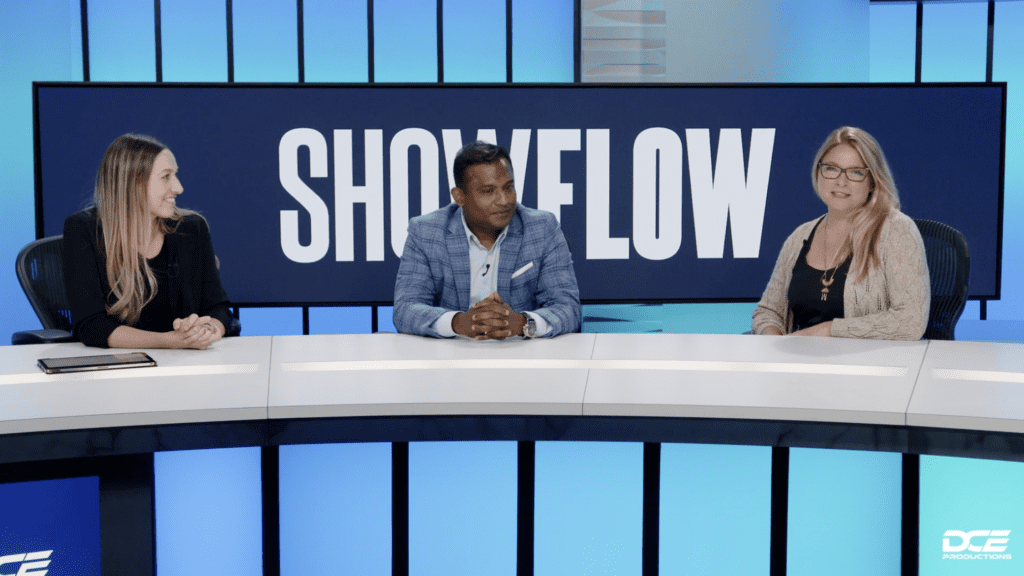
In a recent episode of Showflow, DCE Productions’ podcast series on event production and business storytelling, host Samantha Golden sat down with Ajith Krishnankutty, Head of Experiential Marketing, and Emily Bertsch, Event Experience Manager, inside Capital Group’s Los Angeles headquarters. What followed was a candid conversation about crisis, creativity, and the kind of partnership that changes how an organization shows up in the world.
Starting From Zero: Capital Group’s Virtual Events Challenge
Before 2020, virtual events weren’t even part of Capital Group’s strategy. As Ajith put it, the team was still processing paper surveys and manually uploading Excel sheets into Salesforce. The marketing organization — roughly 350 associates globally — was scattered, under-resourced for digital delivery, and entirely dependent on in-person formats.
Then the pandemic hit.
Their webinar platform at the time was, in Ajith’s words, “a glorified podcasting platform.” There was no video component. But demand exploded almost immediately. Capital Group’s webinar team was suddenly working around the clock to serve North American, European, and Asian clients. The gap between what they had and what they needed had never been more visible.
Emily, who was on the sponsored events team at the time and found her calendar suddenly clear, stepped in to help. That moment of unexpected availability led to her entry into the world of production — and eventually to finding DCE.
What a True Event Production Partnership Looks Like
The early days weren’t flawless — both sides acknowledge that. But the way the two teams grew together is what defines the partnership now.
Capital Group’s event managers had to rapidly re-skill. Terminology like lower thirds, stingers, wipes, and multi-box layouts became part of daily vocabulary. Ajith and Emily were texting each other late at night, screenshotting CNN election coverage and asking: can we do it like this? DCE’s answer was consistently yes — and then they built it.
What made the partnership stick, though, wasn’t just technical capability. It was how DCE handled the people on camera.
“The toughest thing wasn’t pivoting the events team,” Ajith noted. “It was getting the speakers to succeed. The way DCE comforted and oriented them gave Capital a huge advantage — we showed up at the marketplace with the same quality as in-person events, if not more.”
Emily echoed that sentiment. Senior executives recognized DCE team members by voice. They were trusted with high-stakes presentations, complex logistics, and moments where there was no room for error.
When Things Go Wrong: The Real Test of Any Partnership
Perhaps nothing illustrates the depth of this partnership better than what happened when a Conference Center lost all power during a live event. DCE’s team ran extension cords — hundreds of feet — to find a working power source. Capital Group was live and broadcasting before electricity had been restored to the rest of the building.
“It’s not how you act when things are going well that reveals your character,” Emily said. “It’s how you act when things don’t go as planned.”
From Virtual to Hybrid: Expanding the Partnership
As the world opened back up, Capital Group’s event strategy evolved from fully virtual to hybrid — and DCE evolved with them.
The in-person versus virtual divide that used to define events has collapsed. Now it’s about amplification: delivering an experience to a live room while simultaneously broadcasting it to thousands of remote attendees. DCE, already platform-agnostic by philosophy, was built for exactly this.
“You were already thinking ten steps ahead of what we were thinking,” Ajith said. “And you brought that point of view to us.”
The culmination of that evolution was Capital Group’s own in-house studio — a fully reimagined production space on the 55th floor of their LA headquarters. What was once a green curtain and a camera is now a broadcast-quality facility. The first major event produced from the studio, Capital Group’s annual Outlook event, drew more than 5,000 attendees and launched ahead of schedule because both teams had the confidence and planning discipline to pull it off.
The Lesson for Event Teams Everywhere
In a marketing landscape where email open rates hover around 3%, Ajith frames events differently: “To get 5,000 people to sit and watch something for an hour — that’s not a joke. You have a remote in their hand. How do you make sure they don’t change the channel?”
The answer, according to Capital Group, isn’t the platform. It’s the partnership. When someone asks Emily what platform they use to produce such high-quality webinars, her answer is always the same: “It’s not the platform. It’s our partner.”
The right production partner doesn’t just run your tech. They train your speakers, protect your brand, solve crises calmly, and show up the same way every single time — with the same people who already know your executives, your preferences, and your standards.
That’s what Capital Group found in DCE Productions. And that’s what every event team should be looking for.
ShowFlow is a podcast by DCE Productions exploring how event production solves real business challenges. New episodes available wherever you listen to podcasts.