
Better engagement comes down to three design choices.
A real gap sits between how planners rate their events and how the room felt. This post covers what drives that gap and how to close it. Planners who know these three levers can spot the problem early, not after the surveys come back.
Design Sessions for Participation, Not Just Watching
Attendees now expect to take part, not just watch. Two-way formats beat one-way talks. Sessions built on live Q&A, polls, and input from the room hold focus much longer. That holds true no matter how strong the speaker is.
Almost everyone prefers a two-way format. vFairs research cited by Remo found that 92% of attendees prefer interactive events over standard talks. And 67% want live Q&A in the room. Those numbers make a one-way format a real risk, not just a style choice.
Planners tend to rate the room better than the room rates them. Freeman’s trends research found that 78% of planners felt they put on a standout event. But 60% of the people there did not feel the same way. That gap is the clearest sign that engagement must be built, not assumed.
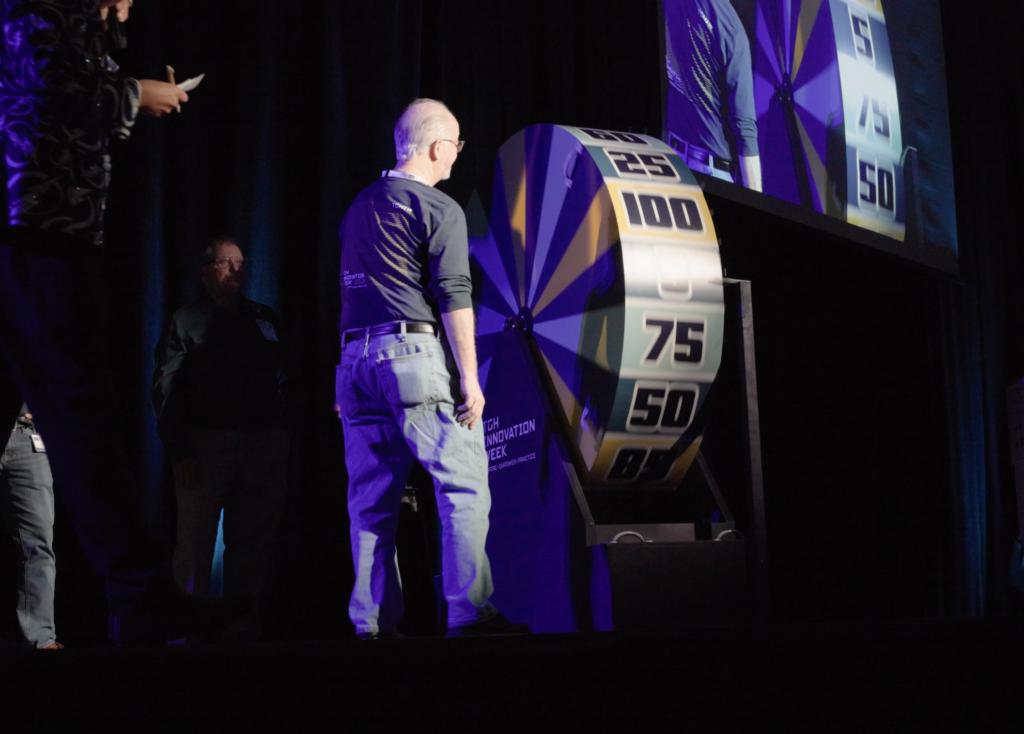
DCE Productions has seen this play out firsthand. During TGH’s Innovation Week 2026, a multi-day program spread across Tampa’s Medical and Research District, simple touch-points between sessions drove real turnout. A spin wheel, a game of plinko, and a swag robot gave people a reason to stop and take part. Each one was easy to share, too. The week logged 5,910 team interactions and 59,419 social shares. That data backs a simple point. The moments between sessions matter almost as much as the ones on stage.
Build Networking Into the Program
Networking is the top reason most people attend at all, yet most planners rate their own networking as weak. To close that gap, treat networking as part of the program. Give it real time, real space, and someone (or a team) to guide it.
Meeting people drives turnout more than content does. Booking.com Business research cited by Remo found that 61% of attendees come to professional events mainly to network. The quality of those meetings shape whether they return next year.
Most planners know they fall short here. Bizzabo’s 2026 benchmark data found that just 15% of planners rate their networking as “very effective.” That marks a sharp drop from past years. Meanwhile, demand for real connection keeps going up.
Built-in tools drive real turnout when they exist. The same Bizzabo data found that 47.3% of attendees take part when apps, live chat, and digital rooms are on hand. Those events log more than 500 messages each on average.
Room layout shapes networking as much as the agenda does. Seating pushed tight to the walls leaves no place to gather. Harsh light or loud bleed in a reception space will shut down talk fast. Networking is partly a room design call.
Use Tech and Production to Cut Friction
People now expect smooth event tech as a baseline. Tech friction kills engagement no matter how good the program is. Production quality decides whether the room focuses on your content or on the problems in the way of it.
Smooth tech is now the floor, not a perk. Freeman’s research found that 73% of attendees expect modern tech to just work at in-person events. And 55% say the mobile app alone can make or break how they rate the whole thing.
Tailored content now shapes how much value people see. vFairs data cited by Remo found that 62% of attendees say AI picks for sessions and matches make the event far more useful. A one-size agenda tends to fall flat.
Ken Holsinger, Senior Vice President of Strategy at Freeman, framed the core idea in the Freeman Q1 2024 Trends Report: “Stronger events come from designing for current audience expectations, not outdated benchmarks.” Engagement plans fail most when planners build for the room they used to have.
Basic AV faults kill focus faster than any weak session does. If the back row cannot hear well enough to decipher what is being said on stage, you lose their attention. Screens too far to see/read have the same effect.
Planner Takeaways
How do I know if my event has an engagement problem? Check your own read of the event against what the survey data says. The gap between how planners score an event and how the room felt is well tracked. If your scores come back lower than your debrief, the gap is real.
What one change will lift engagement the most? Add live input to your general session. Q&A and polls beat one-way talks by a wide margin. Check with your production team that the room can gather and show that input first.
Should networking be scheduled or left open? Schedule it. Open gaps between sessions rarely spark real talk. Set time, guided formats, and digital tools all drive far more uptake than loose breaks in the agenda.
How much does production quality really affect engagement? Production sets the ceiling. People who cannot hear a speaker or read a screen will tune out, no matter how good the program is. Check sound and sightlines from the worst seat before you sign off on a layout.
Internal Sources
Sources
- Remo — 70+ Event Statistics for Organizers in 2026
- Bizzabo — The Events Industry’s Top Marketing Statistics, Trends, and Benchmarks for 2026
- Freeman — Trends Report Q4 2024
- Freeman — Trends Report Q1 2024