
When an event reaches people far beyond the room, you can feel it in the numbers. During TGH’s Innovation Week 2026, the program generated 1.6 million total impressions, 59,419 social engagements, and an estimated 190 million audience reach while still activating dozens of on‑site and system‑wide experiences across Tampa and beyond.
That kind of reach matters because innovation only becomes real when it is shared, understood, and adopted. TGH’s Innovation Week is a multi‑day, system‑wide showcase held throughout the Tampa Medical & Research District and across TGH locations region‑wide, featuring hands‑on technology demonstrations, tours, panels, workshops, watch parties, and live entertainment. With that scale comes a real production challenge: keeping the experience consistent across venues, formats, and audiences while protecting the schedule and maintaining broadcast‑ready quality.
This case study breaks down how the week came together from a production and planning standpoint. See how we approached in‑person, virtual, and hybrid events as distinct yet intertwined experiences, how all the creative engagement pieces increased participation between sessions, and what the analytics reveal about the moments that drove the strongest impact.
In‑person, virtual, and hybrid events—built as distinct yet cohesive experiences
TGH Innovation Week worked because it was designed as a portfolio of experiences, not one centralized conference. TGH positioned the week as a region‑wide event with programming including interactive workshops, tours, demos, watch parties, and live entertainment spread across the district and multiple TGH sites. That design choice changes how production had to function. A ballroom keynote, a rooftop reception, a museum CEO activation, and a virtual training session. All required different production strategies and plans for smooth execution to feel seamless to the audience.
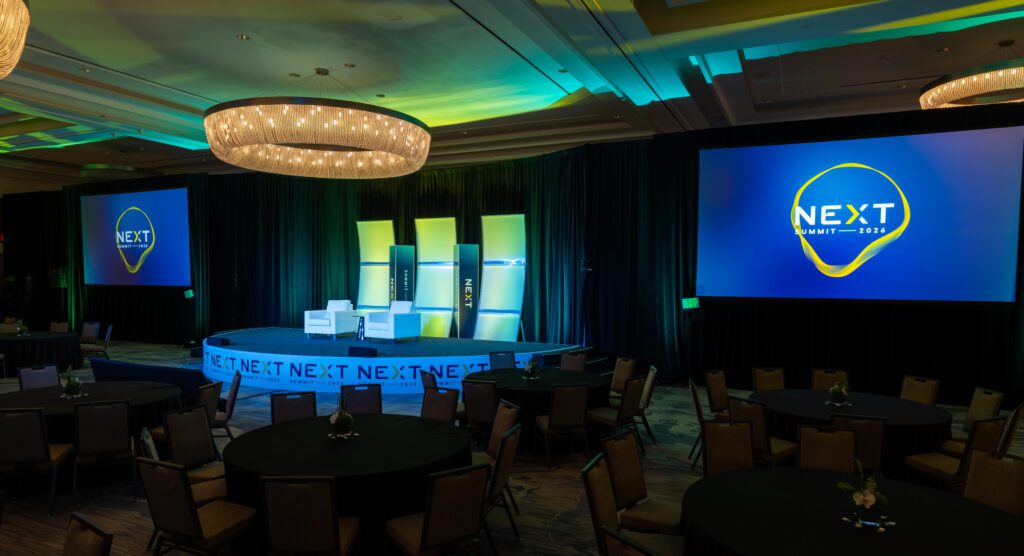
For large, in‑person moments, such as the leadership forum at the Hard Rock Event Center and a summit format at the JW Marriott Tampa Water Street (NEXT Summit 2026), the goal is clarity and confidence: sound that carries without fatigue, content that reads cleanly at distance, and a run of show that keeps pace when you have many speakers and fast transitions. Those big agenda items also demand careful timing around rehearsals, room turns, and cue-to-cue execution, so the audience experiences polish rather than pauses.
For venue-driven experiences—like the CEO keynote and workshop at The Dalí Museum, a concert-style experience at Sparkman Wharf, and a reception at Beacon Rooftop Tampa—the production approach shifts. These environments are about the atmosphere and flow. The space itself is part of the story, so the lighting, audio coverage, and staging have to complement the venue rather than overpower it. In practical terms, that means aligning production with restrictions, access windows, noise considerations, and guest movement, so the experience feels premium without feeling overbuilt.
Innovation Week also included milestone moments tied to the Tampa Medical & Research District. This event coincided with the opening of the 32,000‑square‑foot TGH Innovation Center in Ybor City, described as a hub for TGH Ventures and innovation teams, analytics and IT collaboration, and partner activity. That ribbon‑cutting context matters because these are moments where timing, media presence, and brand presentation are non‑negotiable.
How DCE did it: creative engagement plus full‑service execution
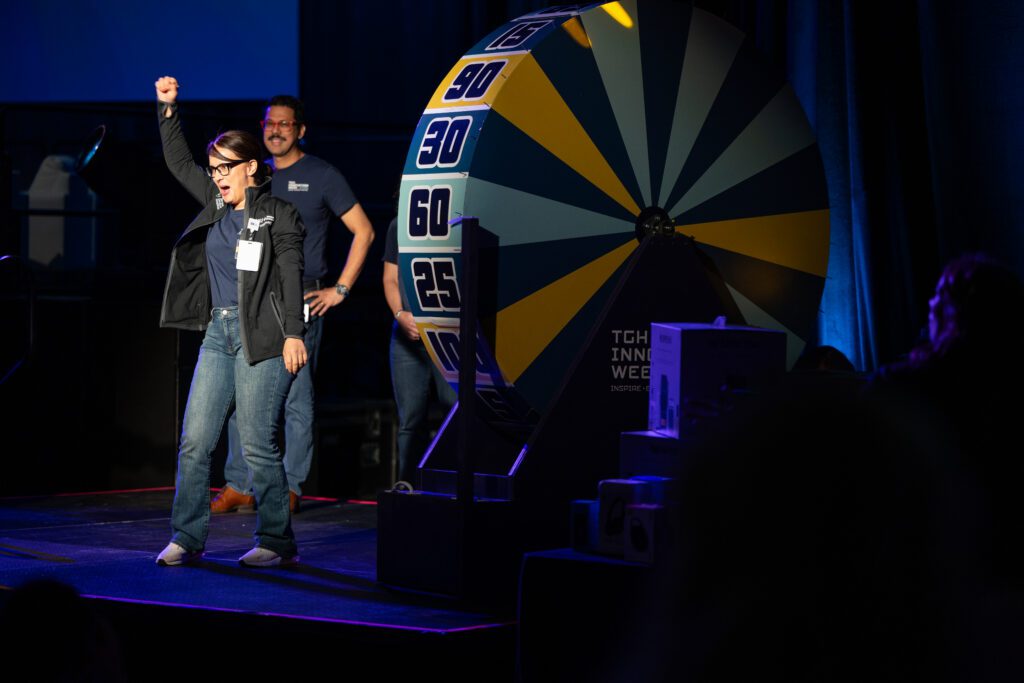
A week-long program succeeds when the “in‑between” moments are as intentional as the stage moments. Innovation Week’s analytics show 5,910 team interactions and 59,419 social engagements, which signals people were doing more than just showing up—they were meaningfully participating. We supported that participation with creative engagement pieces built to spark conversation andkeep energy high between sessions.
Three crowd favorites were the spin game wheel, plinko, and a swag robot. These are simple by design, but strategically effective: they encourage movement, create natural photo moments, and give attendees a reason to stop, engage, and share. That sharing matters when your goal is to amplify innovation stories beyond the immediate audience.
Behind the scenes, the week required operational discipline across multiple venues and formats. Our scope included full-service planning and production support across areas that directly affect attendee experience and schedule integrity, including:
- Food and beverage coordination
- Site visits and renderings to validate layout and flow before show
- Venue contract review and negotiation to protect access, labor windows, and production needs
- Room blocks and vendor selection/contracting/management to keep partners aligned
- Speaker management and support, including and keynote booking assistance
- Transportation logistics support, particularly important with multi-site programming
- Run of show development and management to protect timing and transitions
This is where “event production” becomes more than AV. When you’re running a multi‑venue marathon of individual activations, your best ROI protection comes from mitigating surprises: last‑minute changes, schedule drift, and misaligned vendor expectations. Clear timelines, clear ownership, and early coordination keep the experience smooth for attendees and predictable for stakeholders.
What the numbers tell us: the biggest takeaways from the data
The data shows that Innovation Week succeeded on three levels at once: internal activation, hybrid accessibility, and external amplification. Internally, the scale is clear—5,400 engaged team members across 62 activated events, with 342 physician engagements signaling the week reached clinical stakeholders who influence real adoption. The hybrid layer wasn’t an afterthought either; 1,066 virtual attendees confirm the programming extended meaningfully beyond the rooms in Tampa and St. Pete and supported participation across the broader system. Just as important, the week drove real interaction, not passive attendance—5,910 team interactions suggest people were engaging with the content, the experiences, and each other in a measurable way.
Externally, the visibility was both wide and active. Innovation Week generated 1.6M total impressions and 59,419 social engagements, supported by strong content consumption (54,635 story views) and amplification (170 shares and 200 reposts). The earned media metrics underline that the story traveled beyond owned channels, with 96 mentions, an estimated 190M audience reach, and $1.7M in publicity value. The NEXT Summit numbers show what an anchor event can do inside a week like this: 818,757 social impressions and 31,832 social engagements, with 290 attendees representing 16 states and 150 traveling to Tampa, backed by a deep programming (24 panel discussions and 43 speakers) and cross-sector presence (10 industries represented).
Why this model worked (and what planners can take away)
TGH Innovation Week shows what happens when a multi‑day program is treated like an ecosystem. TGH’s own framing emphasizes a region‑wide showcase with diverse programming. The analytics reinforce that approach: thousands engaged internally, strong mid‑week content lift, and huge earned media outcomes.
For event planners looking to produce a similar scale of activation, three practical takeaways stand out:
Design each format intentionally. In‑person, hybrid, and virtual audiences have different needs. Build the experience around the context, not a one-size-fits-all template.
Protect flow with operational details. Site visits, renderings, vendor alignment, and a tight run of show prevent avoidable friction and protect the attendee experience.
Make the in‑between moments count. Interactive touchpoints drive participation, content capture, and the kind of organic sharing that extends reach.