
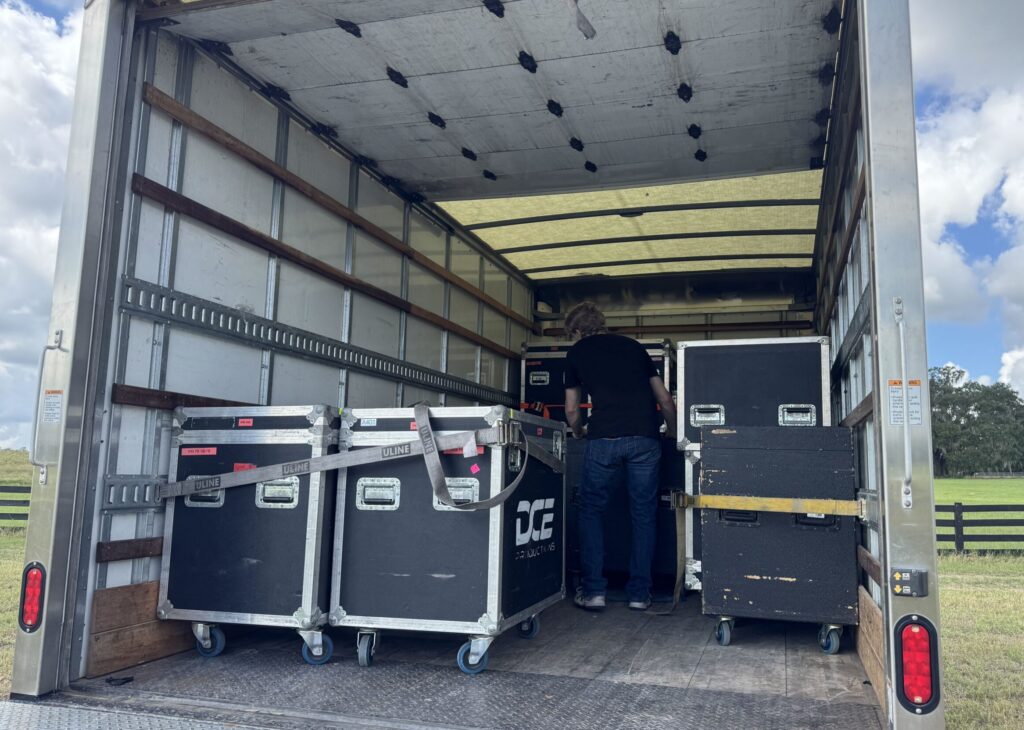
Why does a crew need the room so much earlier than the schedule suggests?
How Long Does AV Setup Take?
No fixed number applies. Setup time is set by the chain above, the venue’s access window, and how far gear must travel a narrow path. Ask your crew to price the build from the floor plan and the dock. An hour count quoted before a site visit is a guess.
- The access window is the real limit. NextLevel Production Services asks planners to confirm the “load-in date, start time, dock or door access window, and load-in cutoff.” A cutoff you learn on the day is a schedule you cannot save.
- The path in matters more than the dock. Lumina warns that gear “that fits easily through a loading dock may have a very different path once it reaches a freight elevator or narrow hallway.” NextLevel asks for elevator “interior dimensions, weight limit, and call procedure.”
- Power limits shape the build. NextLevel asks for “circuit count and rating” at each position. The guide cites “20A, 208V three-phase for higher-load productions.” Thin power means rebuilding the distro mid-load-in.
- The back end is a limit too. NextLevel also asks for the “strike start time, removal deadline” and the dock release time. Lumina notes that some venues have “another event scheduled shortly afterward.” A show booked behind yours shortens both ends of the day.
Where Planners Get Load-In Day Wrong
Three scheduling errors cause most lost time. Planners give every vendor the same window. They leave no room for testing. And nobody from the venue is on site. All three are calendar choices, made weeks out, and all three are cheap to fix.
- Catering and decor share the AV window. Quickstaff’s load-in guidance is direct. “Critical-path trucks – staging, rigging, and core AV – take the earliest windows.” Then “decor, soft goods, and catering come after the heavy work is in motion.” When everyone arrives at once, “mixed directions can jam the whole process.”
- The schedule has no test buffer. Lumina names the cost. “If the production team doesn’t have enough access time, there may not be sufficient opportunity to properly test and troubleshoot the system.” Work backward from the time attendees arrive. Protect the test window first.
- No named venue contact is on site. NextLevel asks for a “final venue check-in with named contact.” Troy Peters, Owner and Chief Experience Officer at SEAS Productions, told AVIXA what holds a show day together: “It’s about that communication. That’s the thing that’s going to set you up for success.” Without that structure, AVIXA notes, too many decision-makers slow things down.
Load-In Day Confirmation Checklist
Confirm every line below in writing, well before the trucks roll. Each item maps to a point above. Most load-in problems trace back to one of these details being left open, and a site visit can settle every one of them.
- Access window: start time, dock access, and load-in cutoff.
- Dock specs: height, door width, and door height for the largest case.
- Depending on your venue, the dock may be managed by a local union. If that is the case, be sure to coordinate with the dockmaster to understand the union’s rules and regulations for dock use.
- Freight elevator: interior size, weight limit, call procedure, and whether a specific certificate of insurance is required to use it.
- You may also need to go through a freight elevator operator, if required by the venue.
- Power: circuit count and rating at each position.
- Vendor order: core AV first, catering and decor after.
- Venue contact: named person, on site, reachable at check-in.
- Test window: protected, not the buffer that gets cut.
- Strike: start time, removal deadline, and dock release time.
FAQ
How much access time should I give the AV crew? Ask the crew, then work backward from the time attendees arrive. The real answer depends on the floor plan, the dock, and the path to the room.
Can non-technical departments set up while AV is still building? Better to stagger it. Staging, rigging, and core AV take the earliest windows. Decor and catering follow once the heavy build is moving. Keep their gear in separate zones until then.
Who needs to be in the room on load-in day? A named venue contact, one decision-maker per work stream, and a content producer on any show with heavy graphics. Nancy Spooner, Founder and CEO of Tempo Live Events, told AVIXA what happens when that content role is missing: “If you don’t have that person, you’re going to feel it very quickly.”
Internal Sources