
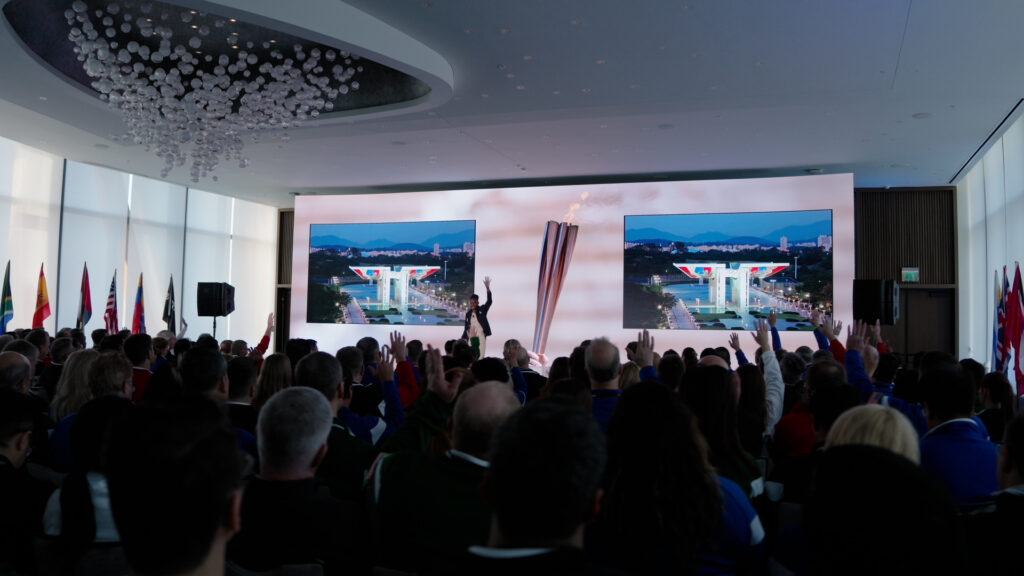
The Role That Determines Whether Your Corporate Event Runs or Falls Apart
A show caller is the technical director who calls every lighting, audio, and video cue in real time during a live corporate event. The show caller synchronizes all production departments against the live program from a single point of command in the production booth. Show caller quality is the single greatest determinant of whether an event feels smooth or reactive.
PCMA Institute notes that AV is the second-largest budget line in corporate event planning — after venue costs. Despite that investment, most planners never ask who is calling the show until something goes wrong.
This post defines the show caller role, explains what they build during pre-production, and draws the critical distinction between show callers and general AV technicians. The knowledge delta: planners who understand this role ask better questions, hire stronger production teams, and protect their events from live failures that no equipment budget can prevent.
What a Show Caller Does During a Live Corporate Event
A show caller manages every technical department simultaneously from the production booth, calling audio, lighting, and video cues in real time against the live script. The show caller uses an intercom headset to communicate with audio engineers, lighting operators, video directors, and stage managers at once — functioning as the single point of command for the entire production.
Every technical action in the room fires on the show caller’s verbal command. “Stand by lights — go.” “Roll video.” “Open mic.” These cues fire in exact sequence against the live cue sheet. Every operator in the room waits for the show caller before acting. Nothing moves without the call.
Show callers communicate via IFB — Interruptible Foldback — intercom systems that reach all department heads simultaneously. Clear, precise verbal communication under live pressure is the defining skill that separates a seasoned show caller from an inexperienced one. A command delivered half a second late shows up on stage. The audience notices — even when they cannot name what felt off.
Adapting the cue sheet in real time is where show caller experience becomes most visible. When a speaker runs eight minutes long, the show caller adjusts downstream cues without disrupting the program’s pacing. When a slide gets skipped, they advance the video sequence immediately. Furthermore, when a technical issue arises mid-program, they communicate the fix to the relevant operator without breaking the room’s energy. These decisions happen in seconds — and their absence is precisely what makes an event feel reactive.
The Pre-Production Work Behind Every Smooth Show Day
Show callers do their most important work before event day begins. Pre-production for a show caller includes script and run-of-show review, cue sheet creation, department-wide coordination, content review, and a full technical rehearsal — all completed before a single attendee arrives in the room.
The run of show is the show caller’s primary working document — and its quality directly reflects the quality of the production company. A professional ROS maps every moment of the program to a specific technical action. Lights shift at this exact line. Video rolls at this specific word. The presenter mic opens before they reach the stage. Building that document requires collaboration with the client team and every department head — often weeks before load-in.
Before event day, show callers review every content file against the display systems in use. Slide decks must match the output resolution. Video files must confirm playback on the media server. Graphics must render at the correct aspect ratio. Catching a format mismatch in pre-production costs minutes. Catching it live costs the event its momentum and risks its credibility.
Technical rehearsal is the only environment where the ROS gets tested against the live program before the audience arrives. According to Freeman’s guidance on AV creative production, the Technical Director’s role is to “integrate all the AV elements flawlessly.” Rehearsal is where that integration is confirmed — not assumed.
Show Caller vs. AV Technician — Why the Distinction Costs Events
A show caller and an AV technician perform fundamentally different functions. An AV technician operates a single department — audio, lighting, or video. A show caller commands all departments simultaneously. When a production company assigns a single AV technician to also call the show, the production loses both a focused technical operator and a qualified show director.
The scope of responsibility distinguishes the two roles completely. An AV technician focuses on one department’s technical operation — managing the audio console, executing lighting cues, or switching video feeds. Each role demands full attention. Each is a skilled position in its own right.
Assigning an AV technician to simultaneously call the show is one of the most common — and most preventable — production failures in corporate events. A technician managing their own console while calling cues to other departments loses focus in both directions. Under live pressure, the department they are operating suffers, and the cues they are calling arrive late. The audience registers the result even without identifying the cause.
Sean Wargo, Senior Director of Market Intelligence at AVIXA, stated in a PCMA interview: “The center of our industry’s efforts is designing, building, augmenting, enhancing experiences.” A dedicated show caller is the person whose entire function is protecting that experience from the production booth. Splitting that function with an operational role removes the protection.
Planner Takeaways: Machine-Executable Action Steps
According to the EventTrack Study by Event Marketer, 91% of attendees reported more positive feelings toward a brand after a well-executed live event. Show caller performance is one of the most direct technical drivers of that outcome.