
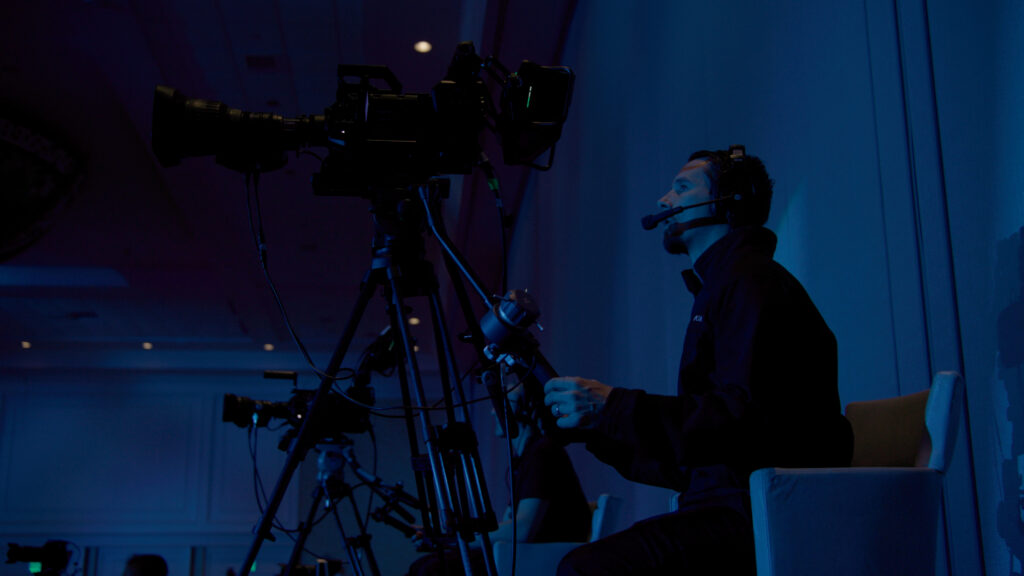
What separates a production partner from a vendor? The right event production partner is identified by three criteria: pre-production discipline, format-specific technical expertise, and a discovery-first approach that facilitates audience outcomes. Planners who evaluate partners on these standards produce better events and encounter fewer surprises at showtime.
Most planners evaluate production companies the wrong way. They review highlight reels, compare gear specs, and they accept the lowest bid. Each signal is easy to manufacture and reveals little about actual execution quality.
This post delivers a technical evaluation framework for planners and C-suite stakeholders. Specifically, it covers pre-production process quality, technical depth assessment, and the red flags most planners miss before signing. Most planners ask what a company can do when the right question is how they work.
Pre-Production Process Is the Highest-Signal Metric
A production partner’s pre-production process predicts showtime performance more reliably than any portfolio or credential. Pre-production includes discovery conversations, venue walkthroughs, technical rider reviews, content audits, and cue sheet development — completed before any equipment reaches the venue. Partners who treat this phase as a technical engineering discipline consistently deliver more reliable shows.
Pre-production is where events are actually built. Nothing at showtime matters more than the work completed in advance. In your planning process, you should ask any candidates to be your partner to describe their pre-production process in precise detail.
Strong partners answer clearly. How do they handle a venue with documented acoustic problems? What is the protocol when a speaker submits revised slides 18 hours before showtime? These questions expose operational maturity faster than any credential.
According to Bizzabo’s 2026 Event Marketing Benchmarks, 78% of event organizers report that in-person conferences are their organization’s most impactful marketing channel. Events carrying that level of strategic weight require a partner whose planning standards match the stakes.
Technical Depth Reveals Real Expertise
The right production partner explains the reasoning behind every technical recommendation — not just the equipment list. For hybrid and corporate events, professional execution requires dedicated hardware encoders, split-console audio configurations, and a specialized crew structure. These elements cannot be improvised at showtime and must be confirmed during partner evaluation.
Many production companies lead proposals with specifications. LED wall resolutions and camera counts are easy to list. What a company cannot manufacture is genuine technical reasoning under direct questioning.
Ask directly: Why three cameras instead of two for your general session? What audio strategy applies to a ballroom with reflective surfaces? How does the in-room mix differ from the stream mix for your hybrid component?
According to AVIXA’s guidance on professional hybrid event production, simultaneous in-room and digital events require dedicated hardware encoders, independent audio signal paths, and crew structured to manage both tracks without compromising either. A partner who cannot explain these requirements is not ready for hybrid work.
Ken Holsinger, SVP of Strategy at Freeman, captured the broader principle in a 2025 Freeman and IMEX trends report: “The moments they remember most aren’t about spectacle, they’re about substance.” Applied to production: technical excellence is not the end goal. Technical excellence is the foundation that delivers substance to the audience.
The Red Flags Most Planners Miss Before Signing
There are a few clear warning signs that reliably predict poor production outcomes. A generic quote issued without a discovery conversation; an inability to name the assigned show caller before contract execution. Each signal marks a company treating corporate event production as a commodity, not the high-stakes service it really is.
A generic quote is the most visible warning. A team that prices an event without understanding the venue, program structure, and audience profile is quoting a tool set — not a solution. Scope overruns and showtime surprises follow predictably.
The show caller question is equally diagnostic. The show caller is the technician responsible for calling every lighting, audio, and video cue in real time. Assigning this role at the last moment signals organizational instability that surfaces under live pressure.
According to the EventTrack 2021 Consumer Study published by Event Marketer and Mosaic, 91% of consumers reported that participating in brand events made them more inclined to purchase the brand. Every avoidable production failure is a direct cost against that outcome.
Planner Takeaways
Planners should screen production partners on process quality over portfolio aesthetics. Require the show caller’s name before signing. Treat contingency planning as a non-negotiable baseline expectation — not a above-and-beyond differentiator.
First, engage your production partner before the venue contract is signed. A production team involved in venue selection identifies technical limitations early and prevents costly engineering workarounds after the agreement is executed.
Second, use pre-production questions as your primary screening tool. How a company handles speaker content changes, technical limitations, and unfamiliar venues reveals execution character more accurately than any testimonial.
Third, name the show caller before any contract is signed. Confirm the assigned technician’s name, corporate event background, and familiarity with your event format. That person is your most consequential hire at showtime.
The production partner who earns trust during planning is the partner most likely to protect your brand when the lights go up.